
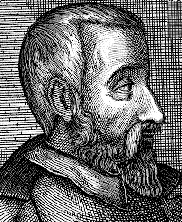
Valdez John (ou Juan), (sometimes written Valdesso, or Val D'esso,) occupies the second place in the "Bibliotheca Antitrinitariorum" of Sandius, who gives the following brief account of him. "John Valdez, a Spanish Noble, a Civilian, and Secretary to the King of Naples, is reported to have brought with him from Germany to Naples the writings of Luther, Bucer, and the Anabaptists. Bernardine Ochinus is said to have imbibed from him his opinion against the received doctrine of the Trinity. He flourished in the year 1542. The Ministers of the united Churches of Poland and Transylvania, Bk. 1, Ch. 3, ' On a false and true Knowledge of the One God the Father, of the Son, and of the Holy Spirit,' write thus. ' Why should we speak also of John Valdez, illustrious both by his descent and his piety, who, leaving us, in his published compositions, specimens of his erudition, writes, that he knows nothing else of God and his Son, than that there is one Most High God, the Father of Christ; and our Lord Jesus Christ, his only Son, who was conceived of the Holy Spirit in the Virgins womb ; and one Spirit of both V "
Bock insinuates, that no one could interpret the above words in an Antitrinitarian sense, who was not himself an Antitrinitarian. But it may be put to any candid Trinitarian, whether he would choose to adopt this declaration of Valdez, as a fair statement of his own opinions; and whether he could conscientiously say, that "he knows nothing else of God and his Son," than what may be found in the above extract.
Valdez's work, entitled, "Considerations on a Religious Life," was originally written in Spanish, and afterwards translated into Latin, and several of the Continental languages. A manuscript copy of the Latin version, written in the year 1558, was deposited in the Offenbachian Library at Frankfort. The Italian version, from which the French, English, Dutch, German and Latin versions were probably made, bears the following title. "Le Cento e dieci divine Consideratione del Signore Giovani Valdesso, nelle quali si Ragiona delle cose piu utili, piu necessarie, et piu perfette della Christiana Professione. In Basilea, 1550," 8vo. Celius Secundus Curio wrote the Preface to it, in which he commends Peter Martyr for bringing it with him, as a great treasure, from Italy, and causing it to be printed at Basle. A French translation of it was published at Lyons, in 8vo., as early as the year 1563, by C.K. [that is, CI. de Kerquisinen]. This was reprinted at Paris in 1565, 16mo. The English translation was made by Nicholas Ferrar, and printed at Oxford, in 4to., A. D. 1638 ; and Dr. Jackson, by whom it was edited, describes it as containing "many learned discourses of experimental and practical divinity, well expressed, and elegantly illustrated ; and yet," he adds, "there be some few expressions and similitudes in it, at which not only the weak reader may stumble, and the envious quarrel; but also the wise and charitable reader may justly blame." Dr. J. afterwards alludes to "suspicious places, and some manifest errors," by which he probably means passages which savour of heterodoxy. Beza speaks of this work in very bitter terms, and represents it as the source whence Ochinus derived his heretical opinions. Bock says, on the other hand, that he has " perceived in these meditations no blasphemies against the word of God, of which they have sometimes been accused, although" he has "read them over again and again;" and he refers to some statements and expressions, which certainly are not wanting in orthodoxy. But it is highly improbable, either that the Ministers, alluded to by Sandius, should have deceived themselves, and misled him, by referring to certain expressions as those of Valdez, which he never penned; or that, in quoting them, to shew the bias of the writer's mind towards Antitrinitarianism, these Ministers should altogether have misapprehended their purport. Walchius places Valdez among "Socinian Commentators," along with such writers as John Crellius, and Dr. John Taylor, of Norwich; and what Bayle has said concerning him, in his Dictionary, has convinced some, that his proper place is among Antitrinitarians. For these reasons, therefore, the present account of him is inserted in the body of this work ; and till arguments more cogent, and more to the purpose, are adduced in favour of the contrary opinion, he must continue to be regarded as an Antitrinitarian.
The chronology of Valdez's life is involved in some obscurity. The earliest account of him is found in two letters, addressed to him by Erasmus, A.D. 1528 and 1529 ; in which he is represented as a young man, no less distinguished by a love of elegant literature, than by sincere Christian piety. From this time he lived chiefly in Italy. In 1535, he went to Naples ; and, according to Antonio Caraccioli, did more to subvert men's minds, than an army of eight thousand German soldiers, who had been previously assembled there, and had carried with them the seeds of the Lutheran heresy. Being a man of literature and refinement, he soon drew around him a number of followers, among whom were Galleazzo Caraccioli, Peter Martyr, and Bernardine Ochinus.
De Porta says, that Valdez ventured to attack the prevalent false opinions respecting good works, and to expose several superstitions; but adds, that his followers did not go beyond the article of Justification, and therefore frequented Church, and continued to attend Mass.
It was not till 1541, that Ochinus's acquaintance with Valdez commenced; and Sandius informs us, that he flourished in 1542. Yet Bayle and others represent his death as having taken place as early as 1540 ; and it appears, from a letter addressed by Bonfadio to Carnesecchi, and published in " Lettere Volgari di diversi Nobilissimi Huomini," (Ald. 1543,) that he was then currently reported to be dead. "I wish we were again at Naples," says Bonfadio ; "but when I consider the matter in another point of view, to what purpose should we go there now, when Valdez is dead ? His death truly is a great loss to us, and to the world ; for Valdez was one of the rarest men in Europe.—Life scarcely supported his infirm and sparebody : but his nobler part, and pure intellect, as if it had been placed without the body, was wholly occupied with the contemplation of truth and divine things. I condole with Marco Antonio (Flaminio), for above all others he greatly loved and admired him."
C. S. Curio, in the Preface to the "Divine Consideratione," says, "Valdez did not much follow the Court after that Christ had revealed himself to him; but abode in Italy, spending the greatest part of his life at Naples, where, with the sweetness of his doctrine, and the sanctity of his life, he gained many disciples unto Christ; and especially among the gentlemen and cavaliers, and some ladies, he was very eminent and praiseworthy in all kinds of praise. It seemed that he was appointed by God for a Teacher and Pastor of noble and illustrious personages: and not this alone, but he gave light to some of the most famous Preachers of Italy, which I very well know, having conversed with them themselves." Valdez wrote
1. Two Dialogues in Italian,—one between Charon and Mercury, and the other between Lactantius and an Archdeacon. Sandius also mentions,
2. Pious and learned Considerations;
3. On some of the Psalms;
4. On the Gospel of Matthew;
5. On the Gospel of John;
6. A Commentary on the Epistle of Paul to the Romans, A.D. 1556; and
7. A Commentary on the first Epistle of Paul to the Corinthians. This Commentary was prohibited in the Spanish Expurgatory Indexes. Vergerius, in his " Animadversions on the First Index of Prohibited Books," attributes one or two other works to Valdez.
(Vidend. Sandii B. A. p. 2. Bock, Hist. Ant. T. I. pp. 980—982; T. II. pp. 315—320. Catal. Universal. Bibl. Uffenbachianae Libr. tam Typis quam Manu exarat. Francof. ad Moen. 1729—1731, 8vo. T. III. N. 31, p. 578. Bezce Opp. T. III. p. 200, Ep. 4. Walchii Bibl. Theol. T. IV. pp. 690. 695. Bayh, Diet. Hist, et Crit. Art. Valdes (jean). Erasmi Opp. T. III. pp. 619. 824. Melch. Adam. Vita Theolog. Exter. Principum, p. 16, col. 2. De Porta, Hist. Ref. Eccles. Raetic., Curiae Ruetorum, 1771—1774, 4to. L. ii. C. i. p. 9. ITCrie's Hist, of the Reformation in Italy, 1833, Ed. 2, Chap. iii. pp. 134, 135. Hist, of the Reformation in Spain, Chap. iv. pp. 140—146.)


/https%3A%2F%2Fekladata.com%2Fn3dNPB_lFAGeHDmCjWNiFSnEXOk%40150x32.gif)
/https%3A%2F%2Fekladata.com%2F86XwM_WWZdghGlkp1GrndbERxcw%40150x32.gif)